























Membuat buku cerita anak tentunya tidak mudah, karena target pembaca yang disasar adalah anak-anak dalam berbagai usia. Bagaimana menyampaikan pesan moral kepada mereka? Bagaimana membuat alur cerita mudah dipahami anak-anak? Bagaimana menciptakan tokoh-tokoh yang menarik dan berkesan? Buku ini akan menjawab pertanyaan-pertanyaan tersebut. Lebih spesialnya lagi, cerita anak yang dimaksud adalah yang bertemakan cerita rakyat Indonesia.
Langkah praktis proses penciptaan buku anak terangkum dalam panduan ini. Mulai dari pemilihan cerita rakyat Indonesia yang cocok dijadikan ide, pembuatan kerangka, karakter, ilustrasi, hingga sampul yang menarik. Fitur penting dalam buku ini adalah tersedianya lembar kerja pada setiap proses, sehingga teori yang disampaikan dapat langsung dipraktikkan.
Kepada seluruh penulis, calon penulis, ilustrator, dan calon ilustrator, mari membaca buku ini dan tidak ragu lagi membuat cerita anak Indonesia!
Ardhyantama, V. (2017). Pendidikan karakter melalui cerita rakyat pada siswa sekolah dasar. Indonesian Journal of Primary Education, 1(2), 95–104.
Andelina, I. R. (2020). Analisis elemen dalam penciptaan karakter desain di dalam Ip Hypnosis Mic-Seiyuu X Rapper Project. Narada: Jurnal Desain Dan Seni, 7(2), 137. https://doi.org/10.2241/narada.2020.v7.i2.001
Artana, I. K. (2017). Anak, minat baca, dan mendongeng. ACARYA PUSTAKA: Jurnal Ilmiah Perpustakaan dan Informasi, 3(1), 26-36. https://doi–org/10.23887/ap.v3i1.12733
Buzan, T., & Buzan, B. (2002). How to mind map. Thorsons.
Cambridge University Press & Assessment. (t.t) Cambridge Dictionary. Diakses pada 29 Mei 2023, dari
https://dictionary.cambridge.org/dictionary/english/mind-map
Djamaris, E., (1984). Menggali khazanah Sastra Melayu Klasik (Sastra Indonesia Lama). Balai Pustaka.
Duggan, A.E. (2016). Folktales and fairy tales: Traditions and texts from around the world, 2nd Edition. Greenwood Press.
Farrelly, T.M. (1993). A new approach to moral education: The integrated character education model. Journal of Correctional Education, 44(2), 76–82. http://www.jstor.org/ stable/41970957
Fathoni, A. C. A., Kartika, R., & Lubis, S. H. (2018). Penerapan physiognomy untuk pengembangan desain karakter pada animasi. Jurnal Dimensi DKV Seni Rupa dan Desain, 3(1), 31–42. https://doi.org/10.25105/jdd.v3i1.2846
Halligan, F. (2013). Movie Storyboards: The art of visualizing screenplays. Chronicle Books.
Hladikova, H. (2014). Children's book illustrations: Visual language of picture books. CRIS-Bulletin of the Centre for Research and Interdisciplinary Study, 1, 19–31. https://doi.org/10.2478/cris-2014-0002
Kuno, N. (2005). Tasteful color combinations. Page One.
Maharsi, I. (2016). Ilustrasi. Dwi-Quantum.
Nurgiyantoro, B. (2010). Sastra anak dan pembentukan karakter. Jurnal Cakrawala Pendidikan, 1(3), 25–40. https://journal.uny.ac.id/index.php/cp/article/download/232/147
Novita, I., Siddik, M., & Hefni, A. (2020). Pengembangan bahan ajar menulis teks cerpen berdasarkan teknik Storyboard pada siswa kelas XI SMA. Diglosia: Jurnal Kajian Bahasa, Sastra, dan Pengajarannya, 3(1), 46–52. https://doi.org/10.30872/diglosia.v3i1.29
Pierce, T. (2010, Oktober 11). Five reasons why children NEED picture books. http://terrypierce.blogspot.cz/2010/10/five-reasons-why-children-need-picture.html
S., Lianawati W. (2019). Menyelami keindahan sastra Indonesia. Bhuana Ilmu Populer.
Sabrina, I., & WS, H. W. H. (2019). Struktur dan fungsi sosial cerita rakyat legenda anak durhaka Awang Tikuluak di Kanagarian Sungai Sariak Kecamatan VII Koto Kabupaten Padang Pariaman. Jurnal Bahasa dan Sastra, 6(3), 337–347. https://doi.org/10.24036/81037250
Self-Publishing School. (2022, Maret 2). How Long Should A Children’s Book Be? Children’s Books Word Count. Self-Publishing School. https://self-publishingschool.com
Saraswati, R. (2014). Distorsi dalam film adaptasi “Snow White” versi Disney dan NonDisney terhadap karya Grimm Bersaudara. Jurnal METASASTRA, 7(1), 85–96. https://core.ac.uk/download/pdf/230546755.pdf
Swales, J.M. (1990). Genre analysis: English in academic and research settings. Cambridge University Press.
Tabrani, P. (2018). Prinsip-prinsip bahasa rupa. Jurnal Budaya Nusantara, 1(2), 173–195. https://doi.org/10.36456/b.nusantara.vol1.no2.a1579
Tsukamoto, H. (2006). Manga Matrix: Create unique characters using the Japanese matrix system. Collins Design.
Toha-Sarumpaet, R. K. (2010). Pedoman penelitian sastra anak. Yayasan Pustaka Obor Indonesia.


This work is licensed under a Creative Commons Attribution-NonCommercial-ShareAlike 4.0 International License.
This book that publish in BRIN Publishing is licensed under a Creative Commons Attribution Non-commercial Share Alike 4.0 International license (CC BY-NC-SA 4.0). This license permits you to share, copy, distribute and transmit the work for your personal use and non-commercial purposes, provided you provide appropriate attribution. Derivative works and modifications must use the same license. Detailed information regarding the CC-BY-NC-SA 4.0 license is available via the link: https://creativecommons.org/licenses/by-nc-sa/4.0/
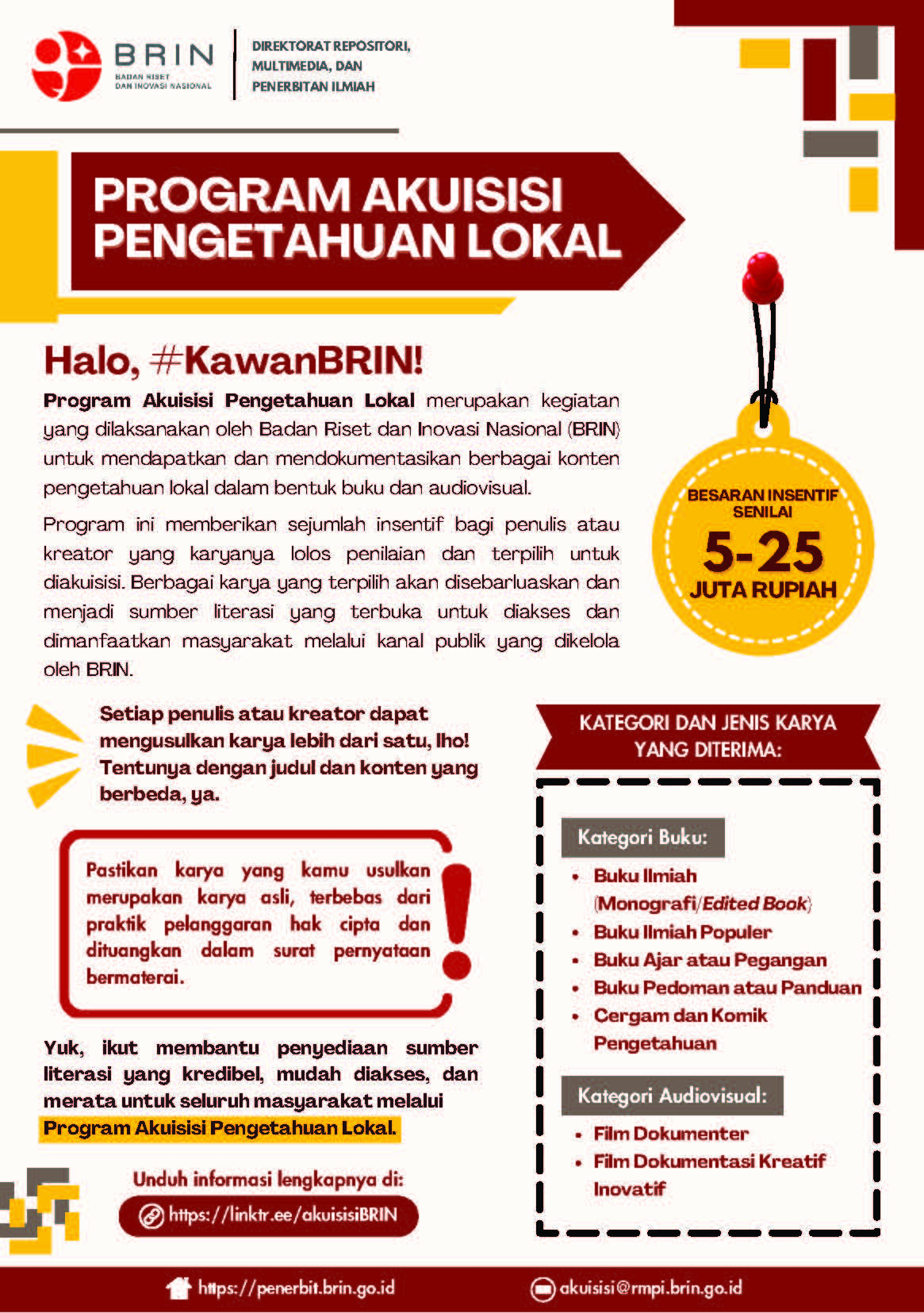
BRIN Publishing has a program named Akuisisi Pengetahuan Lokal that acquisition any of books or audiovisual content that meet our standard publication. The rights of BRIN Publishing is to disseminate and distribute all the content acquisitions for the public.
As an author you (or your employer or institution) may do the following:
All copies, print or electronic, or other use of the paper or article must include the appropriate bibliographic citation for the books