
























Indonesia adalah negara mega-biodiversity yang dianugerahi dengan tingginya keanekaragaman jenis primata, yaitu peringkat ketiga di dunia setelah Brazil dan Madagaskar. Di seluruh kepulauan Nusantara, kita dapat menjumpai berbagai jenis primata eksotis mulai dari kera besar, monyet ekor panjang, monyet daun, hingga primata yang terkecil seperti tarsius. Beberapa jenis primata tersebut juga merupakan hewan endemik, yaitu satwa yang mendiami suatu wilayah dan tidak ditemukan di daerah lain. Ironisnya, sebagian besar jenis primata Indonesia ini dalam status terancam punah akibat ulah predator yang merupakan kerabatnya sendiri, manusia. Perlu adanya suatu upaya untuk meningkatkan kepedulian terhadap kelestarian primata Indonesia, yang tentunya dimulai dengan mengetahui dan mengenalnya.
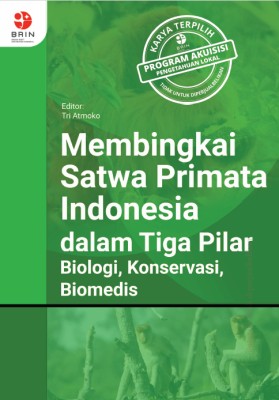
Buku Membingkai Satwa Primata Indonesia dalam Tiga Pilar: Biologi, Konservasi, Biomedis mengenalkan, membahas, dan menginformasikan berbagai topik tentang pilar biologi, konservasi, dan biomedis primata Indonesia yang bermanfaat bagi kesejahteraan hidup umat manusia. Buku ini dapat memberikan manfaat tidak hanya bagi periset atau pegiat primatologi, tetapi juga bagi masyarakat luas sebagai sarana memperkenalkan dan menginformasikan betapa luar biasanya kekayaan satwa primata Indonesia.
Abee, C. R., Mansfield, K., Tardif, S., & Morris, T. (2012). Nonhuman primatas in biomedical research, Volume 2: Diseases (2nd Ed). Elsevier.
Abimanyu, T. L., Mardiastuti, A., Prasetyo, L. B., & Iskandar, E. (2021). Distribution and population estimate of grizzled leaf monkeys in Mount Slamet, Central Java, Indonesia. Dalam IOP Conference Series: Earth and Environmental Science (Vol. 771, 012041). IOP Publishing. https://doi.org/10.1088/1755-1315/771/1/012041
Alferi, Fahri, & Annawaty. (2017). Karakteristik sarang Tarsius wallacei di Lebanu, Sigi, Sulawesi Tengah. J. Sci. Technol., 6(3), 206–213. http://jurnal.untad.ac.id/jurnal/index.php/ejurnalfmipa/article/view/9193/0
Alikodra, H. S. (2019). Ekologi konservasi pengelolaan satwaliar: Hidup harmoni dengan alam. PT. Penerbit IPB Press.
Atmoko, T. (2012). Bekantan Kuala Samboja: Bertahan dalam keterbatasan. Pusat Litbang Konservasi dan Rehabilitasi, Kementerian LHK. https://balitek-ksda.or.id/bekantan-kuala-samboja-bertahan-dalam-keterbatasan/
Badan Pengembangan dan Pembinaan Bahasa. (t.t.). Tersier. Dalam KBBI Daring. Diakses pada 22 April 2024, dari https://kbbi.kemdikbud.go.id/entri/tersier
Bailey, J. A. (1984). Principle of wildlife management. Colorado State University.
Balasubramaniam, K. N., Malaivijitnond, S., Kemthong, T., Meesawat, S., Hamada, Y., Jeamsripong, S., Srisamran, J., Kuldee, M., Thaotumpitak, V., McCowan, B., & Atwill, E. (2021). Prevalence of enterobacteriaceae in wild long-tailed macaques (Macaca fascicularis) in Thailand. J Primatol, 42(3), 1–5.
Barbosa, A. S., Pissinati, A., Dib, L. V., Siquiera, M. P., Cardozo, M. L., Fonseca, A. B. M., Oliveira, A. B., Silva, F. A., Uchoa, C. M. A., Bastos, O. M. P., & Amendoeira, M. R. R. (2015). Balantidium coli and other gastrointestinal parasites in captives non-human primates of the Rio de Janeiro, Brazil. J Med Primatol 44, 18–26.
Bennett, E. & Sebastian, A. C. (1988). Social organization and ecology of Proboscis monkeys (Nasalis larvatus) in mixed coastal forest in Sarawak. International Journal of Primatology, 9(3), 233–255. https://doi.org/10.1007/BF02737402
Beukema, H., Danielsen, F., Vincent, G., Hardiwinoto, S., & van Andel, J. (2007). Plant and bird diversity in rubber agroforests in the lowland of Sumatra, Indonesia. Agrofor Syst, 70(3), 217–242. https://doi.org/10.1007/s10457-007-9037-x
Bismark, M. (1997). Pengelolaan habitat dan populasi bekantan (Nasalis larvatus) di Cagar Alam Pulau Kaget, Kalimantan Selatan [Makalah diskusi hasil penelitian]. Pusat Litbang Hutan dan Konservasi Alam.
Bismark, M. (2009). Biologi konservasi bekantan (Nasalis larvatus). Pusat Penelitian dan Pengembangan Hutan dan Konservasi Alam.
Boardman, W. (2009). Differential diagnosis of diarrhoea in primatas (2nd Ed.). Pan African Sanctuary Alliance Primata Veterinary Healthcare Manual.
Cabana, F., Dierenfeld, E., Wirdateti, Donati, G., & Nekaris, K.A.I. (2017). The seasonal feeding ecology of the javan slow loris (Nycticebus javanicus). Am J Phys Anthropology, 1–15. https://doi.org/10.1002/ajpa.23168
Campbell, C. O., Cheyne, S. M.., & Rawson, B. M. (2015). Best practice guidelines for the rehabilitation and translocation of gibbons. IUCN. https://doi.org/ 10.2305/IUCN.CH.2015.SSC-OP.51.en
Chatterjee, H. J. (2006). Phylogeny and biogeography of gibbons: A dispersal-vicariance analysis. Int J Primatol., 27(3), 699–712. https://doi.org/10.107/s-006-9044-1
Cline, J. M., & Wood, C. E. (2008). The mammary glands of Macaques. Toxic. path., 36, 134–141. https://doi.org/10.1177/0192623308327411
Convention on International Trade in Endangered Species of Wild Fauna and Flora. (2021). Javan gibbon. Diakses pada 31 Desember 2021, dari https://cites.org/eng/gallery/species/mammal/javan_gibbon.html.
Cowlishaw, G., & Dunbar, R. I. M. (1991). Dominance rank and mating success in male primates, Animal Behaviour. Sciencedirect, 41(6), 1045–1056.
David, A. E. S. (2015). The ecology and consevation of Presbytis rubicunda [Tesis tidak diterbitkan]. Oxford Brookes University.
Dewi, F. N., Wood, C. E., Willson, C. J., Register, T. C., Lees, C. J., Howard, T. D., Huang, Z., Murphy, S. K., Tooze, J. A., Chou, J. W., Miller, L. D., & Cline, J. M. (2016). Effects of pubertal exposure to dietary soy on estrogen receptor activity in the breast of Cynomolgus Macaques. Cancer Prev Res (Phila) 9(5), 385–395. https://doi.org/10.1158/1940-6207.CAPR-15-0165
Direktorat Bina Pengelolaan Ekosistem Esensial. (2019). Laporan kinerja Direktorat Bina Pengelolaan Ekosistem Esensial (BPEE), Kementerian Lingkungan Hidup dan Kehutanan.
Direktorat Jenderal Konservasi Sumber Daya Alam dan Ekosistem [Ditjen KSDAE]. (2016). Informasi 521 Kawasan konservasi region Kalimantan dan Sulawesi. Kementerian Lingkungan Hidup dan Kehutanan.
Direktorat Jenderal Perlindungan Hutan dan Konservasi Alam. (2019). Strategi dan rencana aksi konservasi orang utan Indonesia 2019–2029. Kementerian Lingkungan Hidup dan Kehutanan.
Dontu, G., Abdallah, W. M., Foley, J. M., Jackson, K. W., Clarke, M. F., Kawamura, M. J., & Wicha, M.S. (2003). In-vitro propagation and transcriptional profiling of human mammary stem/progenitor cells. Genes Dev. 17, 1253–1270. https://doi.org/10.1101/gad.1061803.potential
Dooley, H. M., Judge, D. S., & Schmitt, L. H. (2013). Singing by male and female Kloss gibbons (Hylobates klossii) in the Peleonan forest, Siberut Island, Indonesia. Primatas, 54, 39–48. https://doi.org/10.1007/s10329-012-0326-2
Eimerl, S. & DeVore, I. (1974). The primatas. Times-Life Books.
Faridha, N. (2014). Deskripsi habitat kedih Presbytis thomasi di Hutan Alam Panton Luas Kecamatan Sama Dua Kabupaten Aceh Selatan [Skripsi tidak diterbitkan]. FKIP Unsyiah.
Ferrucci, L., Nougaret, S., & Genovesio, A. (2019). Macaque monkeys learn by observation in the ghost display condition in the object-in-place task with differential reward to the observer. Sci Rep 9(401). https://doi.org/10.1038/s41598-018-36803-4
Firman. (2021, 19 Februari). Pesona wisata alam Pulau Curiak yang mendunia. Antaranews. https://www.antaranews.com/berita/2009657/pesona-wisata-alam-pulau-curiak-yang-mendunia
Fleagle, J. G. (1988). Primate Adaptation and Evolution. Academic Press.
Florencia, G. (2022, 12 Januari). Tahapan perubahan bentuk payudara saat hamil. Halodoc. https://www.halodoc.com/artikel/tahapan-perubahan-bentuk-payudara-saat-hamil.
Gardiner, M. (2019). A brief assessment of minyak kukang (Slow loris oil). Canopy, 20(1), 25–29.
Garza, J. C., & Woodruff, D. (1992). A phylogenetic study of the gibbons (Hylobates) using DNA obtained noninvasively from hair. Mol Phyl Evol. 1(3), 202–210. https://doi.org/10.1016/1055-7903(92)90016
Geissmann, T. (2002). Taxonomy and evolution of gibbons. Evol Anthropol., 11(1), 28–31. https://doi.org/10.1002/evan.10047
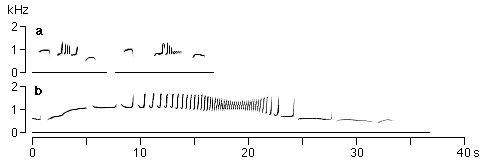
Gibbon Research Lab. (2022). Hylobates klossii [Gambar]. http://www.gibbons.de/main/sound/pics/klos.gif
Google. (t.t.). [Citra Google Maps untuk Kolong Biru, Kecamatan Merawang, Kabupaten Bangka, Kepulauan Bangka Belitung]. Diakses pada 21 Desember 2021, dari https://www.google.com/maps/@-1.9745541,106.1169069,724m/data=!3m1!1e3?entry=ttu
Groves, C. P. (2001). Primata taxonomy. Smithsonian Institution Press.
Groves, C., & Shekelle, M. (2010). The genera and species of Tarsiidae. International Journal of Primatology, 31, 1071–1082. https://doi.org/10.1007/s10764-010-9443-1
Gumert, M. D. (2011). The common monkey of Southeast Asia: Longtailed macaque populations, ethnophoresy, and their occurrence in human environments. Dalam M. D. Gumert, Fuentes, A., & Jones-Engel, L. (Ed.), Monkeys on the Edge: Ecology and Management of Long-tailed Macaques and their Interface with Humans (3–44). Cambridge University Press.
Gurmaya, J. K. (1986). Eology and behavior of Presbytis thomasi in Northern sumatra. Primatas, 27(2), 151–172.
Gursky, S. (1998). Conservation status of the spectral tarsier, Tarsius spectrum: population density and home range size. Folia Primatol., 69 (Suppl. 1), 191–203. https://doi.org/10.1159/000052713
Grove, C. (2000). Primate taxonomy. Smithsionian Institution Press.
Hartig, G., Churakov, G., Warren, W.C., Brosius, J., Makalowski, & Schmiz, J. (2013). Retrophylogenomics Place Tarsiers on the Evolutionary Branch of Anthropoids. Sci. Rep. 3, 1756. https://doi.org/10.1038/srep01756
Hasanah, R., Saepuloh, U., Perwitasari-Farajallah, D., Sinaga, W., Hastuti, Y. T., & Sajuthi, D. (2020). Genetic characterization based on the D-loop MtDNA and the TSPY genes of the dwarf siamang (Hylobates klossii) of Mentawai Island, Indonesia. Biodiv. 21(6), 2854–2861. https://doi.org/10.13057/biodiv/d210664
Hawkeswood, T. J. (2017). Attempted predation on a captive specimen of the Sunda slow loris, Nycticebus coucang (Boddaert, 1785) (Mammalia: Lorisidae) by the Golden tree snake, Chrysopelea ornata (Shaw, 1802) (Reptilia: Colubridae) at Phuket, Southern Thailand, with a review of some published Thailand locality records for C. ornata. Calodema, 580, 1–6. https://www.researchgate.net/publication/320853728_Attempted_predation_on_a_captive_specimen_of_the_Sunda_Slow_Loris_Nycticebus_coucang_Boddaert_1785_Mammalia_Lorisidae_by_the_Golden_Tree_Snake_Chrysopelea_ornata_Shaw_1802_Reptilia_Colubridae_at_Phuke.
Heistermann, M. (2010). Non-invasive monitoring of endocrine status in laboratory primates: Methods, guidelines and applications. Advances Science and Research, 5, 1–9. https://doi.org/10.5194/asr-5-1-2010
Helma. (2013). Deskripsi habitat Tarsius spectrum di Cagar Alam Tangale Desa Labanu, Kecamatan Tibawa Kabupaten Gorontalo [Skripsi tidak diterbitkan]. Universitas Negeri Gorontalo.
Hidayatik, N., Agil, M., Heistermann, M., Yusuf, T. L., Iskandar, E., & Sajuthi, D. (2018a). Assessing reproductive status of spectral tarsier (Tarsius tarsier) using fecal steroid hormone analysis. Am. J. Primatol., 80(11), e22917. https://doi.org/10.1002/ajp.22917
Hidayatik, N., Yusuf, T. L., Agil, M., Iskandar, E., & Sajuthi, D. (2018b). Sexual behaviour of spectral tarsier (Tarsius spectrum) in captivity. Fol. Primatol,, 89, 157–164. https://doi.org/10.1159/000486412
Hirai, H., Hirai, Y., Domae, H., & Kirihara, Y. (2007). A most distant intergeneric hybrid offspring (Larcon) of lesser apes, Nomascus leucogenys and Hylobates lar. Hum Genet., 122(5), 477–483. https://doi.org/10.1007/s00439-007-0425-0
Holger, S., Nekaris, K. A. I., Rode-Margono, J., Ragnarsson, L., Baumann, K., Dobson, J. S., Wirdateti, Nouwens, A., Nijman, V., Martelli, P., Rui Ma, Lewis, R. J., Fai Kwok, H., & Fry, B. G. (2020). The toxicological intersection between allergen and toxin: A structural comparison of the cat dander allergenic protein Fel d1 and the slow loris brachial gland secretion protein. Toxins, 12(86), 1–10. https://doi.org/10.3390/toxins12020086.
Hulka, J. F., & Mohr, K. (1968). Ruminant-like digestion of the langur monkey. Journal Science, 161
International Union for Conservation of Nature. (2015). The IUCN red list of threatened species. Diakses pada 29 Desember 2021, dari http://www.iucnredlist.org/details/10550/0.
International Union for Conservation of Nature and Natural Resources. (2020). The IUCN Red List of Threatened Species (Version 2020-2). Diakses pada 13 Desember 2021, dari www.iucnredlist.org
International Union for Conservation of Nature. (2021). Spectral tarsier. https://www.iucnredlist.org/species/162369551/17978304
Islam, D., Ruamsap, N., Khantapura, P., Aksomboon, A., Srijan, A., Wongstitwilairoong, B., Bodhidatta, L., Gettayacamin, M., Venkatesan, M. M., & Mason, C. J. (2013). Evaluation of an intragastric challenge model for Shigella dysenteriae 1 in rhesus monkeys (Macaca mulatta) for the pre-clinical assessment of Shigella vaccine formulations. APMIS, 122, 463-475.
Izard, M. K., Weisenseel, K. A., Ange, R. L. (1988). Reproduction in the slow loris (Nycticebus coucang). Am J Primatol, 16(4), 331–339. https://doi.org/10.1002/ajp.1350160405
Kaltengtoday.com. (2021, 6 Oktober). Kabupaten Pulang Pisau tetapkan koridor satwa liar bekantan. https://kaltengtoday.com/kabupaten-pulang-pisau-tetapkan-koridor-satwa-liar-bekantan
Khakim, M. F. R., Mardiastuti, A., & Iskandar, E. (2015). Pola pemanfaatan ruang vertikal dan jelajah harian orang utan sumatra (Pongo abelii, Lesson 1827) di Blok Barat Hutan Batang Toru, sumatra Utara. Media Konservasi, 20(2), 125–131. https://doi.org/10.29244/medkon.20.2.%25p
Koda, H., Murai, T., Tuuga, A., Goossens, B., Nathan, S. K. S. S., Stark, D. J., Ramirez, D. A. R., Sha, J. C. M., Osman, I., Sipangkui, R., Seino, S., & Matsuda, I. (2018). Nasalization by Nasalis larvatus: Larger noses audiovisually advertise conspecifics in proboscis monkeys. Science Advances, 4, 1–7. https://doi.org/10.1126/sciadv.aaq0250
Kolappaswamy, K., Nazareno, J., Porter, W. P., & Klein, H. J. (2014). Outbreak of pathogenic Escherichia coli in an outdoor-housed non-human primata colony. J Med Primatol, 43, 122–124.
Kurniawati, D. A., Suwanti, L. T., Lastuti, N. D. R., Koesdarto, S., Suprihati, E., Mufasirin, M., & Pratiwi, A. (2020). Zoonotic potential of gastrointestinal parasite in long-tailed Macaque Macaca fascicularis at Baluran National Park, Situbondo, East Java, Indonesia. Aceh Journal of Animal Science, 5(1), 47–56.
Kuswanda, W. (2014). Orang utan Batang Toru: Kritis di ambang punah. Forda Press. https://www.researchgate.net/publication/316109935_Orang utan_Batang_Toru_Kritis_diambang_Punah
Kuswanda, W., Harahap, R. H., Alikodra, H. S. & Sibarani, R. (2021a). Causal factors and models of human-Tapanuli orang utan conflict in Batang Toru landscape, North sumatra, Indonesia. Agriculture and Natural Resources, 55, 377–386. https://doi.org/10.34044/j.anres.2021.55.3.07
Kuswanda, W., Harahap, R. H., Alikodra, H. S. & Sibarani, R. (2021b). Characteristics and community perception on mitigation of Human-Tapanuli Orang utans conflict around Dolok Sipirok Natural Reserve, South Tapanuli. Dalam IOP Conference Series: Earth and Environmental Science (Vol. 713, 012006). IOP Publishing. https://doi.org/10.1088/1755-1315/713/1/012006
Kuswanda, W., Harahap, R. H., Alikodra, H. S., & Sibarani, R. (2020). Nest characteristics and populations of Tapanuli Orang utans in Batangtoru Landscape, South Tapanuli District, Indonesia. Biodiversitas, 21, 3398–3408. https://doi.org/0.13057/biodiv/d210765
Linnæus, C. (1758). Systema naturæ per regna tria naturæ, secundum classes, ordines, genera, species, cum characteribus, differentiis, synonymis, locis (Tomus I, Editio decima, reformata). Holmiae (Salvius).
Loe, F.R., Tomongo, S., Saepuloh, U., Sajuthi, D., & Suparto, I.H. (2021). Prevalensi dan kepekaan bakteri enteropatogen terhadap antibiotik pada monyet ekor panjang dengan diare di Fasilitas Penangkaran Institut Pertanian Bogor di Dramaga. Jurnal Veteriner. 22(4), 523–530.
MacKinnon, J., & MacKinnon, K. (1980). The behavior of wild spectral tarsiers. Int. J. Primatol., 1, 361–379. https://doi.org/10.1007/BF02692280
MacKinnon, M. (1986). The conservation status of nonhuman primatas in Indonesia. Dalam K. Benirschke (Ed.), Primatas: The road to self-sustaining populations. Springer-Verlag.
Mariya, S., Dewi, F. N. A., Suparto, I. H., Wilkerson, G. K., Cline, J. M., Permanawati, Iskandriati, D., Budiarsa, I. N., & Sajuthi, D. (2017). Mammary gland cell culture of Macaca fascicularis as a Reservoir for Stem Cells. HAYATI Journal of Biosciences, 24, 136 -141
Mariya, S., Dewi, F. N. A., Suparto, I. H., Wilkerson, G. K., Cline, J. M., Permanawati, Iskandriati, D., Budiarsa, I. N., & Sajuthi, D. (2019). Mammosphere culture of mammary cells from cynomolgus macaque (Macaca fascicularis). Comparative Medicine, 69(2), 144–150.
Maulana, V. S., Mardiastuti, Ani., Iskandar, E., Manansang, J. (2019). Kepadatan populasi bilou (Hylobates klossii) di Resort Bojakan, Pulau Siberut, sumatra Barat. Media Konservasi, 24, 237–244. http://repository.ipb.ac.id/handle/123456789/100141
Maulana, V.S. (2019). Habitat dan kepadatan populasi bilou (Hylobates klossii) di Resor Bojakan, Pulau Siberut, sumatra Barat. [Tesis tidak diterbitkan]. Sekolah Pascasarjana IPB University.
Makindi, S. M., Mutinda, M. N., Olekaikai, N. K. W., Olelebo, W. L., & Aboud, A. A. (2014). Human-wildlife conflicts: Causes and mitigation measures in Tsavo Conservation Area, Kenya. Int. J. Sci. Res, 3, 1025–1031.
Melisch, R., & Dirgayusa, I. (1996). Notes on the grizzled leaf monkey (Presbytis comata) from two nature reserves in west Java, Indonesia. Asian Primatas, 6(1–2), 5–11.
Merriam-Webster. (t.t.). Cognitive. Dalam Merriam-Webster.com dictionary. Diakses pada 22 April 2024, dari https://www.merriam-webster.com/dictionary/cognitive
Mukeka, J. M., Ogutu, J. O., Kanga, E., & Roskaft, E. (2019). Human–wildlife conflicts and their correlates in Narok County, Kenya. Glob. Ecol. Conserv., 18, e00620. https://doi.org/10.1016/j.gecco.2019.e00620
Nater, A., Mattle-Greminger, M. P., Nurcahyo, A., Nowak, M. G., de Manuel, M., Desai, T., Groves, C., Pybus, M., Sonay, T. B., Roos, C., Lameira, A. R., Wich, S. A., Askew, J., Davilla-Ross, M., Fredriksson, G., de Valles, G., Casals, F., Prado-Martinez, J., Goosens, B., … Krützen, M. (2017). Morphometric, behavioral, and genomic evidence for a new orang utan species. Current Biology, 27, 3487–3498. https://doi.org/10.1016/j.cub.2017.11.020.
Nekaris, K. A. I., Shekelle, M., Wirdateti, Rode-Margono, E. J., & Nijman, V. (2020). Nycticebus javanicus, Javan slow loris. The IUCN Red List of Threatened Species 2020: e.T39761A86050473. https://doi.org/10.2305/IUCN.UK.2020-2.RLTS.T39761A86050473
Nowak, R. M. (1999). Primates of the world. The Johns Hopkins University Press.
Nijman, V. (1997). Geographic variation in pelage characteristics in Presbytis comata (Desmarest, 1822) (Mammalia: Primatas, Cercopithecidae). Z. Saugetierk, 62, 257–264.
Nijman, V. (1997). On the occurrence and distribution of Presbytis comata (Desmarest, 1822) (Mammalia: primatas, Cercopithecidae) in Java, Indonesia. Contributions to Zoology, 66(4), 247–256. https://doi.org/10.1163/26660644-06604005
Nijman, V., & van Balen, S. (1998). A faunal survey of the Dieng Mountains, Central Java, Indonesia: distribution and conservation of endemic primata taxa. Oryx, 32(2), 145–156. https://doi.org/10.1046/j.1365-3008.1998.d01-24.x
Nijman, V. (2001). Forest (and) Primatas: Conservation and ecology of the endemic primatas of Java and Borneo. Tropenbos International: Wageningen.
Nowak, R. M. (1999). Primatas of the world. The Johns Hopkins University Press.
Nurjaman, Bismark, M., Iskandar, S. (2002). Status populasi dan kondisi habitat surili (Presbytis comata) di Cagar Alam Patengan, Jawa Barat. Berita Biologi 6(3), 455–459.
Oates, J. F., & Davies, A. G. (1994). What ate the colobinae? Dalam A. G. Davies & J. F. Oates (Ed.), Colobinae monkey: Their ecology, behaviour, and evolution. Cambridge University Press.
Peraturan Menteri Lingkungan Hidup dan Kehutanan No. P.20.MENLHK/SETJEN/KUM.1/6/2018 tentang Jenis Tumbuhan dan Satwa yang Dilindungi. (2018).
Perbatakusuma, E. A, Supriatna, J., Siregar, R. S. E., Wurjanto, D., Sihombing, L., & Sitaparasti, D. (2006). Mengarustamakan kebijakan konservasi biodiversitas dan sistem penyangga kehidupan di Kawasan Hutan Alam Sungai Batang Toru Provinsi sumatra Utara [Laporan teknik Program Konservasi Orang Utan Batang Toru]. Conservation International Indonesia-Departemen Kehutanan.
Pocock, R. I. (1934). The Monkeys of the genera Pithecus (or Presbytis) and Pygulhrix found to the East of the Bay of Bengal. Dalam Proceedings of the Zoological Society of London (Vol. 104, No. 4, 895–962). Blackwell Publishing Ltd.
Prongay, K., Park, B., & Murphy, S. J. (2013). Risk factor analysis may provide clues to diarrhea prevention in outdoor-housed rhesus macaques (Macaca mulatta). Am J Primatol, 75(8), 872–882.
Puspita, D. (2019). Karakteristik habitat, populasi, dan sebaran surili (Presbytis comata Desmarest 1822) di Cagar Alam Leuweung Sancang, Kabupaten Garut, Jawa Barat [Tesis tidak diterbitkan]. Institut Pertanian Bogor.
Putro, H. R., Rinaldi, D., Arief, H., Soekmadi, R., Kuswanda, W., Chasanatun, F. N., Rahman, D. A., Kosmaryandi, N., Mijiarto, J., Yudiarti, Y., Hakim, F., Fadillah, R. N. P., & Simangunsong, Y. D. (2019). The ecology of Tapanuli orang utan. Working Group of Batang Toru Sustainable Landscape Management Press.
Rahayu, D.W., Nugroho, E.D. (2015). Biologi molekuler dalam perspektif konservasi. Plantaxia.
Rode-Margono, E. J., Nijman, V., Wirdateti, Nekaris K. A. I. (2014). Ethology of the critically endangered Javan slow loris Nycticebus javanicus E. Geoffroy Saint-Hilaire in West Java. Asian Primates Journal, 4(2), 27–41.
Rode-Margono, E. J., Rademaker, M., Wirdateti, Strijkastra, A., & Nekaris, K.A.I. (2015). Noxius arthropods as potential prey of the venomous Javan slow loris (Nycticebus javanicus) in a West Javan volcanic agricultural system. Journal of natural History, 49, 1949–1959. https://doi.org/10.1080/00222933.2015.1006282
Roos, C., Boonratana, R., Supriatna, J., Fellowes, J. R., Groves, C. P., Nash, S. D., Rylands, A. B., & Mittermeier, R. A. (2014). An updated taxonomy and conservation status review of Asian primatas. Asian Primatas Journal, 4(1), 1–38. http://www.primata-sg.org/storage/asian-primatas-journal/volume-41/2014June24_APJ_Vol4_1.pdf
Ruhiyat, Y. (1983). Socio-ecological study of Presbytis aygula in west Java. Primatas, 24(3), 344–359. https://doi.org/10.1007/BF02381980
Ruskhanidar. (2020). Kajian prospek keberlanjutan kedih (Presbytis thomasi) di Cagar Alam Pinus Jantho Kabupaten Aceh Besar Provinsi Aceh. [Disertasi tidak diterbitkan]. Institut Pertanian Bogor.
Saroyo. (2008). Karakteristik tempat tidur tangkasi (Tarsius spectrum). J Ilmiah Sains, 8, 1–4.
Saroyo, & Koneri, R. (2013). Konservasi primata endemik nokturnal, tangkasi (Tarsius spectrum), melalui kajian distribusi dan estimasi populasi di Sulawesi Utara [Laporan hasil penelitian hibah kompetensi lembaga penelitian]. Universitas Sam Ratulangi. Manado.
Saroyo, Koneri, R., Siahaan, R., Tallei, T. E., Kiroh, H. J., & Repi, T. (2014). Density of tangkasi (Tarsius spectrum) population and development of population estimation method based on duet call at Tangkoko-Batuangus Nature Reserve, North Sulawesi. Current Research Journal of Biological Sciences, 6(1), 42–45. https://maxwellsci.com/print/crjbs/v6-42-45.pdf
Saroyo. (2021). Pariwisata alam di Taman Wisata Alam Batuputih, Kota Bitung, Sulawesi Utara di era pandemi Covid-19. Jurnal Lentera: Penelitian dan Pengabdian Masyarakat, 1(1), 11–14. https://doi.org/10.57207/lentera.v1i1.7
Saroyo. (2021). Riparian di Sulawesi Utara sebagai habitat tangkasi (Tarsius spectrumgurskyae). Jurnal Lentera: Penelitian dan Pengabdian Masyarakat, 2(2), 1–4. https://doi.org/10.57207/lentera.v2i2.22
Sato, K., & Sasaki, S. (2018). Genetic engineering innonhuman primatas for human disease modeling. Journal of Human Genetics, 63, 125–131. https://doi.org/10.1038/s10038-017-0351-5
Sawitri, R., Bismark, M. & Karlina, E. (2013). Ekosistem mangrove sebagai objek wisata alam di Kawasan Konservasi Mangrove dan Bekantan di Kota Tarakan. Jurnal Penelitian Hutan dan Konservasi Alam, 10(3), 297–314. https://doi.org/10.20886/jphka.2013.10.3.297-314
Schapiro, S. J. (2017). Handbook of primata behavioral management. CRC Press.
Setiawan, A., Wibisono, Y., Nugroho, T. S., Agustin, I. Y., Imron, M. A., Pudyatmoko, S., & Djuwantoko. (2010). Javan surili: A survey population and distribution in Mt. Slamet Central Java, Indonesia. Jurnal Primatologi Indonesia, 7, 51–54. https://www.researchgate.net/publication/277729736_Javan_Surili_A_Survey_Population_and_Distribution_in_Mt_Slamet_Central_Java_Indonesia
Setiawan, A., Simanjuntak, C., Saumanuk, I., Tateburuk, D., Dinata, Y., Liswanto, D., & Rafiastanto, A. (2020). Distribution survey of Kloss’s gibbons (Hylobates Klosii) in Mentawai Islands, Indonesia. Biodiversitas, 21(5), 2224–2232. https://doi.org/10.13057/biodiv/d210551
Shekelle, M., Gursky-Doyen, S., & Richardson, M. C. (2013). Family Tarsiidae (Tarsiers). Dalam R. A. Mittermeier, A. B. Rylands, & D. E. Wilson (Ed.). Handbook of the mammals of the world: Volume 3 primatas (236–261). Lynx Edicions.
Shekelle, M., Groves, C. P., Maryanto, I., & Mittermeier, R. A. (2017). Two new tarsier species (Tarsiidae, Primatas) and the biogeography of Sulawesi, Indonesia. Primata Conservation, 31(1),1–9. http://www.primata-sg.org/storage/pdf/PC31_Shekelle_ et_al_Two_new_tarsiers.pdf
Shekelle, M., Groves, C. P., Maryanto, I., Mittermeier, R. A., Salim, A., & Springer, M. S. (2019). A new tarsier species from the Togean Islands of Central Sulawesi, Indonesia, with references to Wallacea and conservation on Sulawesi. Primata Conservation (33), 65–73. http://www.primata-sg.org/storage/pdf/PC33_Shekelle_New_tarsier_species.pdf
Siregar, E. H., Atmowidi, T., & Kahono, T. (2016). Diversity and abundance of insect pollinators in different agricultural lands in Jambi, sumatra. Hayati J. Biosciences, 23(1), 13–17. https://doi.org/10.1016/j.hjb.2015.11.002
Sprague, D. S. (1998). Age, dominance rank, natal status, and tenure among male macaques. American Journal of Physical Anthropology: The Official Publication of the American Association of Physical Anthropologists, 105(4), 511–521.
Srivathsan, A., & Meier, R. (2011). Proboscis monkeys (Nasalis larvatus (Wurmb, 1787)) have unusually high-pitched vocalizations. The Raffles Bulletin of Zoology, 59(2), 319–323. https://www.researchgate.net/publication/263429543_Proboscis_monkeys_Nasalis_larvatus_Wurmb_1787_have_unusually_high-pitched_vocalizations
Steenbeek, R., & van Schaik, C. P. (2001). Competition and group size in Thomas langur (Presbytis thomasi) the folivor paradox revisited. Behavioral Ecology and Sociobiology, 49, 100–110.
Sterck, E. H. M. (1995). Female, food and fights a sociological comparison of the sympatric Thomas langur and long tailed macaque [Tesis tidak diterbitkan]. Utrecht Universiteit.
Stute, P., Wood, C. E., Kaplan, J. R., & Cline, J. M. (2004). Cyclic changes in the mammary gland of cynomolgus macaques. Fertil. Steril. 82, 1160–1170. https://doi.org/10.1016/j.fertnstert.2004.04.035
Sumedi, D. P. (2015, 23 September). Puluhan bekantan diduga terpanggang di hutan Kalimantan. Tempo. https://nasional.tempo.co/read/703036/puluhan-bekantan-diduga-terpanggang-di-hutan-kalimantan/full&view=ok
Supartono, T. (2010). Karakteristik habitat dan distribusi surili (Presbytis comata) di Taman Nasional Gunung Ciremai [Tesis tidak diterbitkan]. Institut Pertanian Bogor.
Supriatna, J., & Ramadhan, R. (2016). Pariwisata primata Indonesia. Yayasan Pustaka Obor Indonesia.
Supriatna, J., Dwiyahreni, A. A., Winarni, N., Mariati, S., & Margules, C. (2017). Deforestation of primata habitat on Sumatra and adjacent islands, Indonesia. Primata Conserv, 31(1), 71–82. https://www.researchgate.net/publication/317674178_Deforestation_of_Primata_Habitat_on_Sumatra_and_Adjacent_Islands_Indonesia
Supriatna, J., & Ramadhan, R. (2016). Pariwisata primata Indonesia. Buku Obor.
Supriatna, J. (2019). Field guide to the primatas of Indonesia. Yayasan Pustaka Obor.
Supriatna, J., & Wahyono, E. H. (2000). Panduan lapangan primata Indonesia. Yayasan Obor.
Susanto, A.G. (2011). Genetika. Graha Ilmu.
Syafutra, R. (2016). Habitat dan populasi mentilin (Cephalopachus bancanus bancanus) di Kabupaten Bangka [Tesis tidak diterbitkan]. Institut Pertanian Bogor.
Syaukani. (2012). Study of population and home range of Thomas Langur (Presbytis thomasi) at Soraya Research Station, Leuser Ecosystem. Jurnal Natural, 12(1), 37–41.
Taman Nasional Siberut (2022). Home [Laman Facebook]. Facebook. Diakses pada 21 April 2024, dari https://web.facebook.com/photo/?fbid=153536826970754&set=a.153 536816970755
Tejaswi, K. P., Kumara, H. N. and Kumar, S. (2013). Gaadli. Dalam S. Radhakrishna, M. A. Huffman, & A. Sinha (Ed.), The macaque connection (Vol. 43, 127–133). Springer.
Tropenbos Indonesia. (2018, 17 Desember). MoU on EEA Management of orang utan corridor in Sungai Putri–Gunung Tarak – Gunung Palung Landscape.
Umroni, U. (2020, 4 Mei). Keluar cairan putih dari payudara saat hamil 9 bulan. Alodokter. https://www.alodokter.com/komunitas/topic/kesuburan-asi.
Undang-Undang Nomor 5 Tahun 1990 tentang Konservasi Sumber Daya Alam Hayati dan Ekosistemnya. (1990). https://peraturan.bpk.go.id/Home/Details/46710/uu-no-5-tahun-1990
Van Noordwijk, M., & Van Schaik, C. (1985). Male migration and rank acquisition in wild long-tailed macaques (Macaca fascicularis). Animal Behaviour, 33(3), 849–861.
Visvader, J. E., & Stingl, J. (2014). Mammary stem cells and the differentiation hierarchy: Current status and perspectives. Gene & Development, 28, 1143–1158. https://doi.org/10.1101/gad.242511.114
Voris, H. K, & Museum, F. (2000). Maps of Pleistocene sea levels in Southeast Asia: Shorelines, river systems and time durations. J Biogeography, 27, 1153–1167. https://doi.org/10.1046/j.1365-2699.2000.00489.x
Vun, V. F., Mahani, M. C., Lakim, M., Ampeng, A. & Md-Zain, B. M. (2011). Phylogenetic relationships of leaf monkeys (Presbytis; Colobinae) based on cytochrome b and 12S rRNA genes. Genet. Mol. Res., 10(1), 368-381. https://doi.org/10.4238/vol10-1gmr1048
Wahyuni, T. (1999). Bakteri enteropatogen pada monyet ekor panjang (Macaca fascicularis) tingkat keterpaparan dan pola kepekaannya terhadap beberapa antibiotik [Tesis tidak diterbitkan]. Institut Pertanian Bogor.
Weitzel, V. & Groves, C. (1985). The nomenclature and taxonomy of the colobine monkeys of Java. International Journal of Primatology, 6(4), 399–409. https://doi.org/10.1007/BF02736386
Whittaker, D. J. (2005). Evolutionary genetics of kloss's gibbons (Hylobates klossii): systematics, phylogeography and conservation [Disertasi]. Michigan State University.
Whittaker, D. J. (2006). A conservation action plan for the Mentawai Primatas. Primata Conservation, (20), 95–105. http://dx.doi.org/10.1896/0898-6207.20.1.95
Whittaker, D. J., & Geissmann, T. (2008). Hylobates klossii. The IUCN Red List of Threatened Species 2008: e.T10547A3199263. http://dx.doi.org/10.2305/ IUCN.UK.2008.RLTS.T10547A3199263.en.
Wich, S. A., Romy, S., Sterch, E. H. M., Korstjens, A. H., Willems, E. P., & Van Shaick, C. P. (2007). Demography and life history of Thomas langur (Presbytis thomasi). American Journal of Primatology, 69,641–651.
Widiana, A., Hasby, M.R., & Wisnu, U. 2018. Distribusi dan estimasi surili (Presbytis comata) di Kamojang Kabupaten Garut Jawa Barat. Al-Kauniyah Jurnal Biologi, 11(2), 116–121. https://doi.org/10.15408/kauniyah.v11i2.6621
Wiens, F. (2002). Behavior and ecology of wild slow lorises (Nycticebus coucang): Social organization, infant care system, and diet [Disertasi]. Bayreuth University.
Wijaya, E. A., Rahayuningsih, Y., Rahajoe, J. S., Ubaidillah, R., Maryanto, I., Walujo, E. B., & Semiadi, G. (2014). Kekinian keanekaragaman hayati Indonesia. LIPI Press. http://penerbit.lipi.go.id/data/naskah1432194926.pdf
Wilting, A., Sollmann, R., Meijaard, E., & Helgen, K. M. (2012). Mentawai’s endemic, relictual fauna: Is it evidence for Pleistocene extinctions on sumatra? J Biogeogr., 39, 1608–1620. https://doi.org/10.1111/j.1365-2699.2012.02717.x
Wirdateti. (2005). Pengamatan Nycticebus coucang (Kukang) di Taman Nasional Gunung Halimun. Fauna Indonesia, 5(2), 49–54.
Wirdateti, & Dahrudin, H. (2006). Pengamatan habitat, pakan dan distribusi Tarsius tarsier (tarsius) di Pulau Selayar dan TWA Patunuang, Sulawesi Selatan. Biodiversitas, 9(2), 152–155. https://smujo.id/biodiv/article/download/399/420/418
Wirdateti, Mulyadi, Erniwati, Widodo, W., Nugraha, R. T. P., Dwibadra, D., Murniati, D. C., & Yulianto. (2017). Pengamatan jenis fauna di wilayah Pekalongan, Jawa Tengah [Laporan Perjalanan Program DIPA]. Puslit Biologi-LIPI.
Wirdateti. (2012). Sebaran dan habitat kukang jawa (Nycticebs javanicus) di area Perkebunan Sayur Gunung Papandayan, Kabupaten Garut. Berita Biologi, 11(1), 113–120. https://doi.org/10.14203/beritabiologi.v11i1.1887
Wu, A., Dong, Q., Gao, H., Shi, Y., Chen, Y., Zhang, F., Bandyopadhyay, A., Wang, D., Gorena, K. M., Huang, C., Tardif, S., Nathanielsz, P. W., & Sun, L-Z. (2016). Characterization of mammary epithelial stem/progenitor cells and their changes with aging in common marmosets. Sci. Rep., 6, 32190. https://doi.org/10.1038/srep32190
Zannah, R. (2017). Analisis vegetasi pohon di plot fenologi pos monitoring Sikundur Taman Nasional Gunung Leuser [Skripsi tidak diterbitkan]. Universitas Medan Area.
Zanzani, S. G., Gazzonis, A. L., Epis, S., Manfredy, M. T., & Nakauchi, K. (2016) Study of the gastrointestinal parasitic fauna of captive non-human primatas (Macaca fascicularis). Parasitology Research, 115(1), 307–312.

This work is licensed under a Creative Commons Attribution-NonCommercial-ShareAlike 4.0 International License.