





















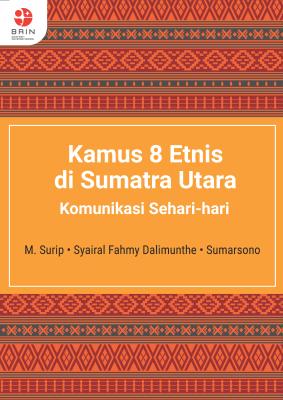
Buku Kamus 8 Etnis di Sumatra Utara: Komunikasi Sehari-hari ini disusun berdasarkan latar belakang pola penggunaan bahasa daerah yang cenderung mengkhawatirkan, terutama generasi muda yang kurang peduli terhadap pelestarian bahasa daerahnya dan lebih ke arah bahasa gaul berbasis media sosial. Penyusun telah menabulasi entri data bahasa daerah delapan etnis khas Sumatra Utara yang diorientasikan pada penggunaan bahasa keseharian masyarakat dalam kehidupan sosialnya. Semua data yang dientri merupakan data hasil analisis tim penyusun yang pilihan diksinya memang aktif digunakan sebagai bahasa sosial masyarakat dalam kehidupan sehari-hari dalam kehidupan. Penyusunan kamus ini berorientasi pada kosakata bahasa Indonesia yang kemudian diterjemahkan ke dalam bahasa daerah khas delapan etnis Sumatra Utara. Selain itu, juga dilengkapi dengan contoh penggunaan kosakata bahasa daerah ke dalam bentuk ujaran untuk memudahkan pembaca dalam pemakaian.
Penyusunan kamus ini merupakan suatu bentuk upaya untuk menyuguhkan kebaruan dalam literasi keberagaman dan kekayaan budaya dan bahasa di Indonesia. Penyusunan kamus ini juga diharapkan dapat membantu baik masyarakat Sumatra Utara maupun pelajar dan pengajar dalam menggunakan kosakata bahasa daerah untuk keperluan komunikasi sehari-hari dan dijadikan referensi dalam pembelajaran muatan lokal di tingkat sekolah dasar hingga sekolah menengah atas. Buku kamus ini sangat baik dan diperlukan bagi masyarakat Sumatra Utara dan pengguna bahasa di berbagai daerah dalam mempertahankan keutuhan bahasa daerah.
Selamat membaca!
Andreas Lingga, S. (2002). Terjemahan Pustaka Lak-lak ke dalam aksara Latin. Disparsenibud Pemkab Simalungun.
Chaer, A. (2007). Leksikologi & leksikografi Indonesia. Rineka Cipta.
Hidayat, Z. A. (2016). Kamus bahasa Simalungun-Indonesia. Badan Pengembangan dan Pembinaan Bahasa.
Hondro, R. K., Hsb, Z. A., Suginam, S., & Sianturi, R. D. (2016). Implementasi algoritma Knuth Morris Pratt pada aplikasi penerjemahan bahasa Mandailing-Indonesia. Jurikom (Jurnal Riset Komputer), 3(4), 49–53.
Kridalaksana, H. (2008). Kamus linguistik. PT. Gramedia Pustaka Utama.
Lase, A. (2011). Kamus Liniha Nias-Indonesia. Kompas Media Nusantara.
Nursiwan, N. (2013). Klasifikasi leksikostatistik bahasa Melayu Langkat, bahasa Melayu Deli, dan bahasa Dairi Pakpak. Suluk Indo, 2 (1), 1–10.
Said, S. H. (2013). Kamus peribahasa Melayu. Pelangi Publishing.
Siregar, A. M. (2017). Pola dasar kalimat bahasa Batak Toba. Language Maintenance and Shift.
Tim Penyusun Kamus Pusat Bahasa. (2005). Kamus Besar Bahasa Indonesia. Edisi Ketiga. Balai Pustaka.
Zubeirsyah, M. H., Abidin, Z., Lubis, N., Siregar, B. U., Dahlan, F., Sulaiman, T. A., & Safii, Z. (2001). Kamus bahasa Simalungun-Indonesia. Balai Pustaka.

This work is licensed under a Creative Commons Attribution-NonCommercial-ShareAlike 4.0 International License.
This book that publish in BRIN Publishing is licensed under a Creative Commons Attribution Non-commercial Share Alike 4.0 International license (CC BY-NC-SA 4.0). This license permits you to share, copy, distribute and transmit the work for your personal use and non-commercial purposes, provided you provide appropriate attribution. Derivative works and modifications must use the same license. Detailed information regarding the CC-BY-NC-SA 4.0 license is available via the link: https://creativecommons.org/licenses/by-nc-sa/4.0/
BRIN Publishing has a program named Akuisisi Pengetahuan Lokal that acquisition any of books or audiovisual content that meet our standard publication. The rights of BRIN Publishing is to disseminate and distribute all the content acquisitions for the public.
As an author you (or your employer or institution) may do the following:
All copies, print or electronic, or other use of the paper or article must include the appropriate bibliographic citation for the books